


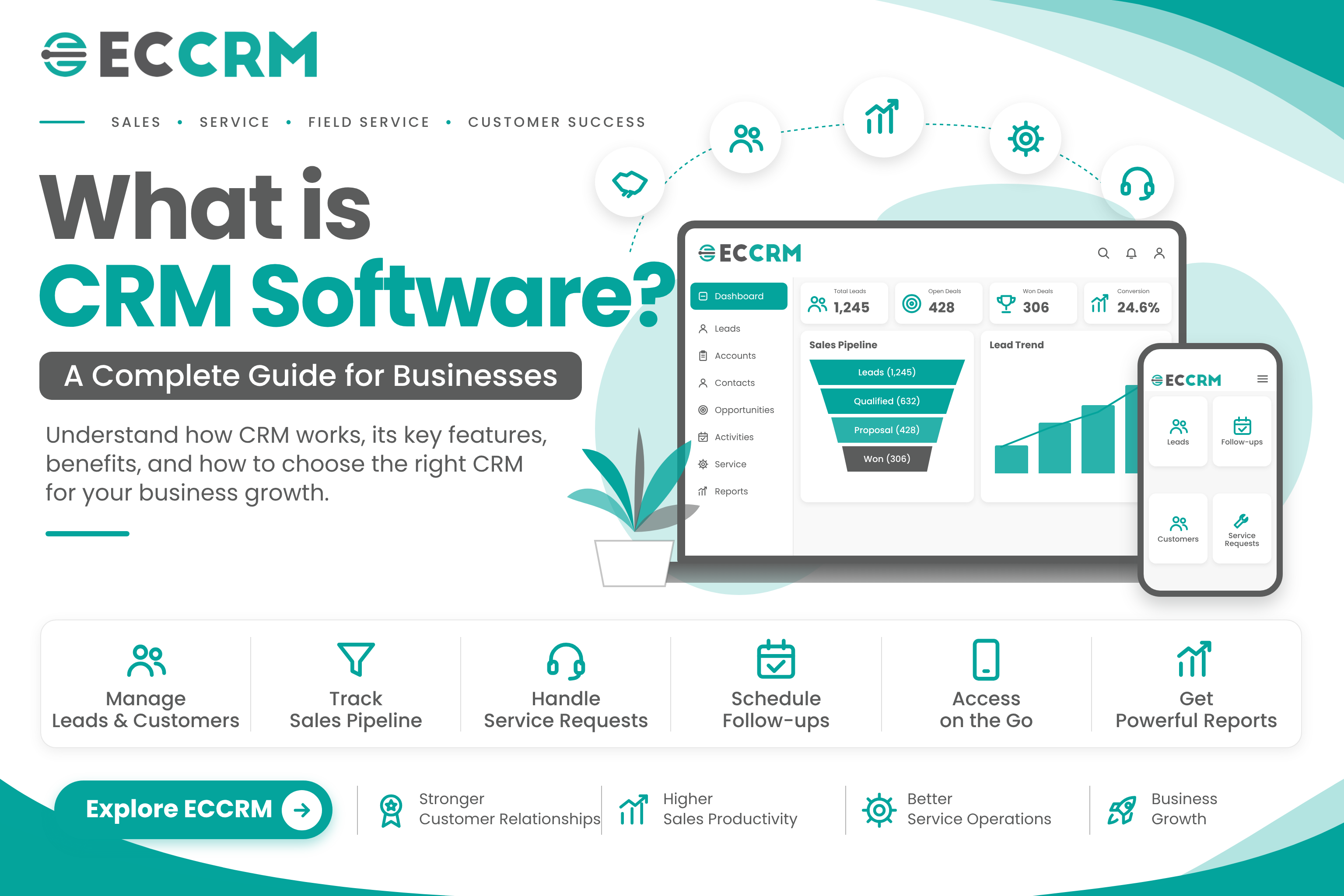
What is CRM Software? Features, Benefits & Complete Business Guide
Every customer interaction creates an opportunity for a business. A website enquiry can become a new customer. A follow-up call can turn an interested prospect into a confirmed sale. A timely service response can strengthen a long-term customer relationship.
But how effectively does your business manage these interactions?
As businesses grow, customer information often becomes scattered across spreadsheets, emails, phone records and different applications. Sales representatives may struggle to remember follow-ups, managers may have difficulty tracking opportunities, and service teams may not have access to previous customer interactions.
These challenges can affect sales coordination, customer satisfaction and everyday business operations.
This is where CRM Software becomes an important business tool.
Customer Relationship Management (CRM) Software helps businesses organise customer information, manage sales activities, track enquiries, coordinate service operations and maintain better visibility throughout the customer lifecycle.
Whether you operate a small business, a manufacturing company, a service organisation or a growing enterprise, the right CRM system can help bring customer-facing activities together in one organised platform.
But CRM software is much more than a digital customer database. It can support the entire process of managing prospects, building customer relationships, converting opportunities and providing ongoing service.
In this complete guide, we will explain what CRM software is, how it works, its essential features, different types, business benefits, industry applications and how to choose the right CRM solution.
What is CRM Software?
CRM software (Customer Relationship Management software) is a business application that helps organisations manage customer information, track interactions, organise sales activities and improve customer relationships throughout the customer lifecycle.
Instead of maintaining customer information in multiple spreadsheets, emails or separate applications, a CRM system centralises relevant information so authorised employees can access it when needed.
A CRM platform helps businesses organise activities such as:
- Storing and managing customer and prospect information.
- Capturing website enquiries and business leads.
- Tracking sales opportunities and sales pipeline stages.
- Assigning leads to sales representatives.
- Scheduling calls, meetings and customer follow-ups.
- Creating and managing quotations.
- Recording customer communication and interaction history.
- Managing customer complaints and service requests.
- Coordinating field service activities, where supported.
- Monitoring sales and service team activities.
- Generating reports for business analysis and decision-making.
A simple example of how CRM software works
Imagine a company that receives enquiries from its website, telephone calls, email campaigns and sales representatives.
Without a CRM system, each employee may maintain separate customer records. One salesperson might record an enquiry in Excel, another might save customer details in their phone, and a manager might maintain a separate sales report.
This creates gaps in communication and makes it difficult to understand the actual progress of an enquiry.
With CRM software, the business can follow a more organised process:
- A potential customer submits an enquiry through the company website.
- The enquiry is recorded in the CRM as a new lead.
- A sales manager assigns the lead to a salesperson.
- The salesperson contacts the prospect and records the discussion.
- A follow-up activity is scheduled.
- A quotation is prepared and the sales opportunity is updated.
- After the sale, relevant customer information can support future service interactions.
Instead of treating every interaction as a separate activity, the business maintains a more connected customer record.
In simple terms, CRM software helps businesses understand their customers, organise their teams, manage sales opportunities and build stronger customer relationships.
Why Do Businesses Need CRM Software?
Customer relationship management involves much more than maintaining names, telephone numbers and email addresses.
Every enquiry, conversation, meeting, quotation, purchase, complaint and follow-up contributes to the customer's experience with a business.
When these activities are handled manually, important information can easily be overlooked.
Consider a business receiving 50, 100 or even more enquiries every month. As the number of customers and employees increases, managing every interaction through individual spreadsheets and messages becomes increasingly complicated.
Sales managers may not know which enquiries have received a response. Sales representatives may forget to contact prospects at the right time. Service employees may not have access to previous customer complaints or service records.
These are common situations where a business starts looking for CRM software for managing customers and sales operations.
Common business challenges that CRM software helps address
| Business challenge | How CRM software helps |
|---|---|
| Scattered customer information | Maintains organised customer records |
| Missed enquiries | Helps capture and track leads |
| Delayed follow-ups | Supports task scheduling and reminders |
| Unclear sales progress | Provides sales pipeline visibility |
| Disconnected departments | Makes relevant customer information accessible to authorised teams |
| Poor customer history | Maintains available interaction records |
| Unorganised service requests | Supports structured ticket and service management |
| Limited management visibility | Provides reports and dashboards |
A CRM system gives businesses a more structured way to manage these activities.
The objective is not simply to replace Excel with another application. It is to establish a consistent process for managing customer relationships across the organisation.
How Does CRM Software Work?
CRM software works by bringing customer-related information and business activities into a shared system.
Whenever a customer interacts with a business, relevant information can be recorded, updated and accessed by authorised employees.
The exact workflow depends on the organisation and the capabilities of its CRM platform, but a typical process looks like this.
1. Lead Capture and Enquiry Management
The customer journey often begins when someone shows interest in a product or service.
An enquiry may arrive through:
- Website contact forms.
- Telephone calls.
- Email enquiries.
- Social media campaigns.
- Online advertisements.
- Trade exhibitions.
- Sales representatives.
- Existing customer referrals.
The CRM system helps record these enquiries as leads or prospects so the business can organise and manage them.
2. Customer Information Management
Once an enquiry is recorded, the business can maintain relevant customer details.
These may include:
- Customer name and contact information.
- Company name and business details.
- Enquiry source.
- Product or service requirements.
- Assigned sales representative.
- Communication history.
- Related sales opportunities.
Having organised customer information helps employees understand the background of each enquiry.
3. Lead Assignment and Sales Follow-Ups
Sales managers can assign leads to appropriate representatives based on their responsibilities and internal processes.
Sales employees can record calls, schedule meetings, create tasks and maintain follow-up dates.
This helps businesses manage enquiries systematically and gives managers better visibility into how leads are progressing.
4. Sales Pipeline Management
Once a prospect shows interest, the sales opportunity can move through different stages of the sales pipeline.
For example:
- New enquiry
- Initial contact
- Requirement discussion
- Product demonstration
- Quotation submitted
- Negotiation
- Order confirmation
- Won or lost
A sales pipeline provides an overview of opportunities at different stages. Managers can identify pending quotations, opportunities requiring attention and deals that have remained inactive.
5. Quotation and Opportunity Management
When a prospect is ready to evaluate a product or service, the sales team may prepare and share a quotation.
A CRM system with quotation management capabilities helps maintain relevant quotation records and connect them with the corresponding customer or sales opportunity.
This gives employees better access to the history of commercial discussions.
6. Customer Service and Post-Sales Management
The relationship does not end when a customer makes a purchase.
Customers may require installation assistance, product information, maintenance, repairs or technical support.
Depending on the CRM platform, service teams can record customer requests, assign responsibilities, update service status and maintain interaction history.
7. Reports and Performance Monitoring
Managers can review available reports and dashboards to understand sales activities, lead progress, pending follow-ups and service operations.
This information helps management identify bottlenecks and decide where additional attention may be required.
The complete process: CRM software connects customer enquiries, sales activities and ongoing customer interactions through a more organised workflow.
What Are the Important Features of CRM Software?
When evaluating the best CRM software for your business, looking at the feature list is only the first step. The more important question is whether those features support your actual business processes.
A sales-driven organisation may prioritise lead management and sales pipeline tracking, while a maintenance company may require service request management and technician scheduling.
Here are ten important CRM software features businesses should understand before selecting a solution.
1. Lead Management Software
Lead management is one of the most important capabilities of a sales CRM.
It helps businesses capture, organise, assign and monitor potential customers from different enquiry sources.
For example, a company may receive enquiries from its website, marketing campaigns, telephone calls and sales representatives. A lead management system provides a structured way to record these enquiries and monitor their progress.
Important capabilities include:
- Lead creation and registration.
- Lead source tracking.
- Lead assignment.
- Lead status management.
- Lead conversion tracking.
- Follow-up activity management.
2. Contact and Account Management
Customer information is valuable only when employees can find and use it when needed.
Contact and account management helps businesses maintain organised records of customers, prospects and associated companies.
Employees can access relevant information, including contact details, company information, communication history and associated sales opportunities.
3. Sales Pipeline Management
Sales pipeline management gives businesses a structured view of their sales opportunities.
Instead of asking every salesperson for individual updates, managers can review opportunities based on their current stages.
For example, a sales manager may identify:
- New enquiries awaiting contact.
- Prospects requiring product demonstrations.
- Quotations awaiting customer approval.
- Opportunities under negotiation.
- Deals ready for closure.
4. Task and Follow-Up Management
A successful sales process requires consistent communication.
CRM software with task and follow-up management helps employees organise calls, meetings, appointments and reminders.
Sales representatives can plan their daily activities and maintain records of completed and pending tasks.
5. Quotation and Sales Order Management
For businesses that regularly prepare quotations, maintaining commercial records is an important part of customer management.
A CRM system with relevant quotation and sales order capabilities can help teams organise these activities alongside customer and opportunity records.
6. Customer Service and Ticket Management
A customer may contact a business after purchasing a product because of a technical issue, complaint, maintenance requirement or general support request.
Service CRM software helps businesses record and organise these requests.
Depending on the platform, capabilities may include:
- Service request creation.
- Complaint and ticket management.
- Ticket assignment.
- Priority and status tracking.
- Customer communication records.
- Service history management.
7. Field Service Management
For businesses that send technicians or service employees to customer locations, field service management is an important CRM capability to evaluate.
It helps connect office-based service coordinators with employees working in the field.
Relevant capabilities may include:
- Technician assignment and scheduling.
- Service request allocation.
- Work order management.
- Field employee tracking.
- Digital service reports.
- Customer service history.
- AMC and warranty management.
- Mobile access for field technicians.
8. Mobile CRM Application
Sales representatives, field technicians and managers may not always work from an office.
A mobile CRM application gives authorised employees access to supported customer and business information through smartphones or tablets.
Depending on the application, users may be able to:
- View assigned leads and customer information.
- Check scheduled activities.
- Update follow-up records.
- Access service requests.
- Record field activities.
- Review available customer history.
9. CRM Reports and Analytics
A CRM system should help managers understand what is happening across their customer-facing operations.
Reports and dashboards may provide information about:
- Lead sources and lead status.
- Sales pipeline progress.
- Sales representative activities.
- Pending customer follow-ups.
- Quotations and opportunities.
- Service requests.
- Technician activities.
- Customer-related performance indicators.
10. CRM Workflow Automation
As business activities increase, employees may spend considerable time performing repetitive administrative tasks.
CRM workflow automation helps reduce some of this manual effort through predefined rules and processes.
Depending on the software, automation may support:
- Automatic task creation.
- Activity notifications.
- Lead assignment rules.
- Follow-up reminders.
- Workflow approvals.
- Status-based notifications.
Looking for a CRM to Manage Sales and Service Operations?
Explore how ECCRM can help organise customer enquiries, sales activities and service workflows in one platform.
Explore ECCRMWhat Are the Different Types of CRM Software?
Not every CRM system is designed for the same purpose. Some platforms focus primarily on sales, while others specialise in customer support, data analysis or collaboration.
Understanding the different types of CRM software helps businesses identify the right solution for their requirements.
1. Operational CRM
Operational CRM focuses on organising customer-facing business activities.
It commonly supports sales, marketing and customer service processes.
For example, a business may use operational CRM to capture leads, assign sales representatives, schedule follow-ups and manage customer service requests.
2. Analytical CRM
Analytical CRM focuses on analysing customer-related information to identify patterns, trends and business opportunities.
It can help businesses understand customer behaviour, sales performance and engagement patterns, depending on the available data and analytical tools.
3. Collaborative CRM
Collaborative CRM helps different departments share relevant customer information and coordinate their activities.
For example, sales and service employees can refer to available customer records to understand previous interactions and maintain continuity.
4. Sales CRM Software
Sales CRM software focuses on managing the sales process, from capturing enquiries to tracking opportunities and closing deals.
Common capabilities include:
- Lead management.
- Contact management.
- Sales pipeline management.
- Sales activity tracking.
- Task and follow-up management.
- Quotation management.
- Sales reports.
5. Service CRM Software
Service CRM software focuses on customer support and post-sales service management.
It can help businesses organise customer complaints, service requests, support tickets, maintenance activities and service history.
Some service CRM platforms also provide field service management capabilities.
Bring Your Sales and Service Teams Together with ECCRM
Discover a CRM platform designed to support customer relationship management, sales coordination and service operations.
Discover ECCRMSales CRM vs Service CRM: What Is the Difference?
Although both are part of customer relationship management, sales CRM and service CRM address different stages of the customer journey.
| Comparison | Sales CRM | Service CRM |
|---|---|---|
| Main purpose | Manage sales opportunities | Manage customer service activities |
| Primary users | Sales representatives and managers | Service coordinators and support teams |
| Main activities | Lead tracking and sales follow-ups | Service requests and complaints |
| Opportunity management | Sales pipeline | Service workflow |
| Scheduling | Calls, meetings and appointments | Service appointments and technician schedules |
| Customer records | Prospects and sales accounts | Customers and service history |
| Performance tracking | Sales activities and opportunities | Service activities and request status |
Some CRM platforms combine sales and service capabilities, allowing businesses to manage multiple customer-facing activities through a connected system.
What Are the Benefits of CRM Software for Businesses?
Investing in CRM software is not simply about moving customer information from spreadsheets into a digital application.
The real value comes from improving how employees manage customer interactions, organise activities and coordinate their responsibilities.
Here are some important benefits of CRM software.
1. Centralised Customer Information
When customer information is maintained in different locations, employees may spend unnecessary time searching for records.
CRM software provides a centralised system for maintaining relevant customer information and associated activities.
This helps authorised employees access available records without depending entirely on individual spreadsheets or personal notes.
2. Better Lead Management and Conversion Opportunities
Every business enquiry deserves appropriate attention.
With lead management software, sales teams can capture enquiries, assign responsibilities, monitor lead status and schedule follow-ups.
This creates a more organised approach to handling potential customers.
It does not automatically guarantee more sales, but it can help businesses manage their opportunities more consistently.
3. Improved Sales Pipeline Visibility
Sales managers need to understand where opportunities stand.
CRM software helps organise opportunities according to their sales stages, making it easier to identify pending quotations, inactive prospects and deals requiring attention.
This supports better sales planning and opportunity management.
4. More Consistent Customer Follow-Ups
A customer may enquire today but make a purchase several weeks later.
Maintaining consistent communication throughout this period is important.
CRM task management, reminders and activity tracking help sales representatives plan follow-ups and maintain a record of previous interactions.
5. Better Coordination Between Departments
Customer information is relevant to more than one department.
Sales employees may need to understand previous service issues. Service coordinators may need access to customer and product information. Managers may require visibility across both operations.
A CRM platform can provide authorised teams with access to relevant shared information.
6. Organised Customer Service Operations
Customer service involves managing requests, assigning responsibilities, recording interactions and monitoring progress.
Service CRM capabilities help businesses create a more structured approach to handling these activities.
For companies with field employees, additional field service management capabilities can help coordinate technicians and service appointments.
7. Improved Employee Productivity
Employees often spend time searching for information, preparing manual reports and coordinating activities through multiple communication channels.
A CRM system can bring relevant information and workflows together, reducing some of this administrative effort.
The productivity benefit depends on how well the software is configured and adopted by employees.
8. Better Management Visibility
Managers need more than verbal updates to understand business performance.
CRM dashboards and reports can provide information about available leads, sales activities, opportunities, pending follow-ups and service operations.
This helps management identify operational gaps and review progress.
9. Better Customer Experience
Customers appreciate consistent communication and employees who understand their previous interactions.
When relevant information is available to authorised teams, businesses can provide more informed responses and maintain continuity across customer interactions.
10. Support for Business Growth
As businesses expand, the number of customers, enquiries and employee activities also increases.
A structured CRM system helps organisations manage this growing volume of information and activities more consistently.
Ready to Organise Your Sales and Customer Service Activities?
Explore how ECCRM can help your business manage customer information, sales opportunities and service operations through a connected CRM platform.
Explore ECCRMCRM Software vs Excel: Which Is Better for Managing Customers?
Many businesses begin by managing customer details through Excel spreadsheets.
For a small business with a limited number of customers and simple requirements, spreadsheets may be sufficient.
However, as the organisation grows, managing customer records, follow-ups and sales activities through multiple spreadsheets can become challenging.
Consider a business where five sales representatives maintain separate customer files. The sales manager may need to collect updates manually to understand the overall sales pipeline.
If a customer contacts another department, employees may not know whether that customer already has an ongoing enquiry or unresolved issue.
A dedicated CRM system is designed to address these customer management challenges.
| Business requirement | Excel spreadsheets | CRM software |
|---|---|---|
| Customer information | Maintained in spreadsheets | Organised customer records |
| Lead tracking | Manual updates | Structured lead management |
| Follow-up reminders | Requires manual tracking or separate tools | CRM task and reminder capabilities |
| Sales pipeline | Manually maintained | Dedicated opportunity stages |
| Team coordination | Depends on file sharing and updates | Shared access based on permissions |
| Customer history | Spread across files and notes | Centralised interaction records |
| Service requests | Separate manual tracking may be needed | Ticket and service management, if supported |
| Reports | Manual preparation | Available reports and dashboards |
| Workflow automation | Limited or requires additional tools | Workflow automation, depending on the platform |
When Should a Business Move from Excel to CRM Software?
Consider moving to a CRM system when:
- Multiple employees manage the same customers.
- Enquiries are arriving from several sources.
- Sales follow-ups are becoming difficult to track.
- Managers cannot easily understand the sales pipeline.
- Customer information is frequently duplicated.
- Customer service activities need better coordination.
- Manual reporting is taking considerable employee time.
The important distinction: Excel is a spreadsheet tool, whereas CRM software is designed to manage customer relationships and related business workflows.
The right decision depends on your business size, processes and requirements.
Who Should Use CRM Software?
CRM software is useful for businesses that regularly interact with customers, manage enquiries, coordinate sales activities or provide ongoing services.
It is not limited to large enterprises. Small and medium-sized businesses can also benefit from a CRM system when their customer management requirements become more complex.
CRM Software for Small Businesses
Small businesses often have limited sales teams and multiple responsibilities assigned to individual employees.
CRM software can help organise enquiries, maintain customer records, schedule follow-ups and track sales opportunities.
It provides a more structured approach as the business grows.
CRM Software for Manufacturing Companies
Manufacturing businesses regularly communicate with dealers, distributors, procurement teams and end customers.
A CRM system can help organise customer accounts, sales enquiries, quotations, business opportunities and after-sales service activities.
Manufacturers looking for better visibility into customer relationships can consider CRM software alongside their existing ERP and production systems.
CRM Software for IT and Software Companies
IT and software companies may manage enquiries from different industries, multiple sales opportunities and ongoing client relationships.
CRM software can support lead tracking, client communication, quotation management, sales activities and customer support processes.
CRM Software for Trading and Distribution Businesses
Trading and distribution companies manage customer enquiries, dealer relationships, quotations and regular business communication.
A CRM system helps organise customer records and sales opportunities while giving managers better visibility into sales activities.
CRM Software for Service-Based Businesses
Service businesses often manage customer requests, appointments, complaints and recurring service requirements.
Service CRM software can help coordinate these activities and maintain relevant customer history.
CRM Software for Equipment and Maintenance Companies
Businesses dealing with equipment installation, repairs and maintenance may need to manage service requests, technician schedules, work orders, AMC contracts and warranty-related activities.
A CRM platform with field service management capabilities can help connect customer service operations with field employees.
CRM Software for Real Estate and Consulting Businesses
Real estate companies, consultants and professional service providers often manage multiple enquiries and long customer decision-making processes.
CRM software can help track prospects, schedule meetings, record communication and monitor opportunities.
Find the Right CRM Approach for Your Business
See how ECCRM supports sales and service teams with organised customer management and business workflows.
Visit ECCRM WebsiteHow to Choose the Best CRM Software for Your Business
Searching for the best CRM software can produce hundreds of options. Each CRM provider may offer different features, pricing structures, deployment models and levels of customisation.
However, the most popular CRM is not necessarily the best CRM for your organisation.
The right solution is the one that supports your business requirements, fits your workflows and can be adopted consistently by your employees.
Before selecting a CRM platform, evaluate these ten important factors.
1. Identify Your Business Requirements
Start by understanding the challenges you want the CRM to solve.
Ask yourself:
- Do you need to capture and manage sales enquiries?
- Do you want to monitor your sales representatives?
- Do you need a structured sales pipeline?
- Are customer follow-ups frequently delayed?
- Do you need to manage customer complaints?
- Do you have field technicians who require scheduling?
- Do you want to connect sales and service activities?
Create a list of requirements and separate essential features from optional ones.
This will make comparing CRM solutions much easier.
2. Evaluate CRM Features
A long feature list does not necessarily indicate a better CRM system.
Focus on the features your employees will actually use.
For example, a sales-focused organisation may prioritise lead management, sales pipeline tracking and quotation management.
A maintenance company may require service request management, technician scheduling, work order tracking and mobile applications.
Evaluate each CRM against your actual workflows.
3. Check Ease of Use
A CRM platform should be practical for everyday business activities.
If employees find the system difficult to understand, they may continue using spreadsheets and personal records instead.
During a product demonstration, check how easily employees can:
- Create a customer record.
- Register a new enquiry.
- Assign a lead.
- Schedule a follow-up.
- Update a sales opportunity.
- View customer history.
- Generate relevant reports.
A simple and understandable workflow can support better employee adoption.
4. Check Mobile CRM Accessibility
If employees frequently visit customers or work outside the office, mobile access becomes important.
Evaluate whether the CRM offers mobile applications for the activities your employees perform.
For field teams, check whether they can access assigned service requests, update job information and record relevant activities through supported mobile features.
5. Review Customisation Options
Different businesses follow different processes.
A CRM should be able to accommodate relevant business requirements such as custom fields, workflows, approval processes, reports and user responsibilities.
Understand which changes are available through configuration and which require additional development.
6. Check Integration Capabilities
Businesses often use multiple applications to manage their operations.
Your CRM may need to connect with:
- Website enquiry forms.
- Email applications.
- ERP software.
- Accounting applications.
- Communication platforms.
- Other business applications.
Check whether the CRM supports the integrations your organisation actually requires.
Do not assume every provider offers the same integration options.
7. Evaluate Security and User Permissions
CRM systems may contain customer contact details, business information and commercial records.
Evaluate the provider's security practices and available user access controls.
Important considerations include:
- User roles and permissions.
- Access restrictions.
- Data backup arrangements.
- Data protection practices.
- Authentication and account security.
- Data export and recovery options.
Choose a provider that can explain how customer information is protected and managed.
8. Compare CRM Software Pricing
CRM software pricing can vary depending on the provider and available capabilities.
Before selecting a solution, understand the complete cost structure.
Consider:
- User licences.
- Subscription or licence charges.
- Implementation costs.
- Customisation charges.
- Integration costs.
- Training expenses.
- Maintenance and support.
- Additional storage or usage charges, where applicable.
The cheapest option may not always provide the features or support your business requires.
Compare the total cost against the actual business value.
9. Evaluate Implementation and Customer Support
CRM implementation involves more than installing an application.
Businesses may need to organise existing customer data, configure workflows, assign user permissions and train employees.
Ask the provider about:
- Implementation assistance.
- Data migration support.
- Employee training.
- Product documentation.
- Technical support availability.
- Maintenance and updates.
Reliable implementation and support can make a significant difference to the overall CRM experience.
10. Request a Live CRM Software Demo
A product demonstration is one of the best ways to understand whether a CRM solution suits your business.
Do not evaluate a CRM only through screenshots or feature descriptions.
Ask the provider to demonstrate your actual business scenarios.
For example, request a demonstration of how the software handles a new enquiry, assigns a salesperson, schedules a follow-up, creates a quotation and maintains the customer record.
If you operate a service business, ask to see how service requests are created, assigned and monitored.
This helps you make a more informed purchasing decision.
See How ECCRM Can Support Your Business
Explore ECCRM's sales and service CRM capabilities and understand how a connected platform can support your customer management workflows.
Explore ECCRMCloud-Based CRM Software vs On-Premise CRM Software
Another important consideration when selecting CRM software is the deployment model.
Businesses generally evaluate cloud-based and on-premise CRM solutions based on their IT infrastructure, accessibility requirements, security considerations and budget.
What Is Cloud-Based CRM Software?
Cloud-based CRM software is hosted on cloud infrastructure and accessed through the internet.
Depending on the provider, it may offer:
- Access through supported web browsers.
- Remote access for authorised employees.
- Provider-managed infrastructure.
- Subscription-based pricing options.
- Cloud-based updates and maintenance.
- Access across supported devices and locations.
Cloud CRM software is often considered by businesses that need flexible access for employees working from different locations.
What Is On-Premise CRM Software?
On-premise CRM software is deployed on infrastructure managed by the organisation or its chosen hosting provider.
It may provide greater control over certain infrastructure and deployment decisions.
However, the organisation may also be responsible for server management, maintenance, updates, security arrangements and backup procedures.
Cloud CRM vs On-Premise CRM: Comparison
| Evaluation area | Cloud-based CRM | On-premise CRM |
|---|---|---|
| Hosting | Cloud infrastructure | Organisation-managed infrastructure |
| Accessibility | Internet-based access | Depends on deployment configuration |
| Infrastructure management | Often managed by the provider | Managed by the organisation or hosting partner |
| Updates | Provider-managed, depending on service | Managed according to deployment arrangement |
| Initial investment | Often subscription-based | May require infrastructure investment |
| Maintenance | Depends on provider agreement | Greater internal management responsibility |
| Customisation | Depends on platform | Depends on software and infrastructure |
Which CRM Deployment Model Should You Choose?
There is no single deployment model that suits every organisation.
Cloud-based CRM may be appropriate when businesses require remote access and provider-managed infrastructure.
On-premise CRM may be worth evaluating when organisations have specific infrastructure or deployment requirements.
Consider your budget, internal IT capabilities, accessibility requirements and data management policies before making a decision.
How Much Does CRM Software Cost?
One of the most common questions businesses ask before selecting a CRM is how much it costs.
The price of CRM software depends on several factors, and there is no universal price that applies to every organisation.
Some providers offer subscription-based pricing, while others offer different licensing or implementation arrangements.
Factors That Influence CRM Software Pricing
Number of users: The number of employees who require CRM access can influence the overall cost.
Available features: Basic contact management and advanced sales and service capabilities may have different pricing structures.
Deployment model: Cloud-based and on-premise deployment can involve different cost arrangements.
Customisation: Businesses requiring specialised workflows, fields or reports may need additional configuration or development.
Integrations: Connecting CRM with ERP, accounting or other applications may involve additional expenses.
Implementation and training: Data migration, employee training and initial configuration can contribute to the total investment.
Ongoing support: Maintenance, technical assistance and service arrangements should also be considered.
How to Evaluate CRM Software Value
Rather than selecting a CRM based only on the lowest price, consider whether it supports your actual business requirements.
A useful evaluation should include:
- Does it manage the customer information you need?
- Can your sales team manage enquiries and follow-ups?
- Can managers monitor sales opportunities?
- Does it support your service operations?
- Can employees access relevant information when required?
- Does the provider offer implementation and support?
The right CRM should provide appropriate value for the organisation's requirements and expected usage.
Common CRM Implementation Mistakes Businesses Should Avoid
Selecting good CRM software is important, but implementation also plays a major role in its success.
Some businesses invest in CRM applications but continue using manual processes because the system was not configured around their actual workflows.
Avoid these common mistakes.
1. Choosing CRM Software Without Understanding Requirements
Selecting software based only on popularity or a long feature list can lead to unnecessary complexity.
Identify your business processes before comparing providers.
2. Trying to Implement Every Feature at Once
Introducing too many features at the beginning can make implementation difficult for employees.
Start with essential processes such as customer records, lead management and follow-ups. Introduce additional workflows progressively.
3. Ignoring Employee Training
Employees need to understand how and why they should use the CRM system.
Provide practical training based on their daily responsibilities.
4. Migrating Incomplete or Duplicate Customer Data
Existing spreadsheets may contain outdated contact details, duplicated records or inconsistent formats.
Review and organise the information before migrating it into the CRM.
5. Not Defining User Responsibilities
Employees should understand who is responsible for lead assignment, customer follow-ups, opportunity updates and service requests.
Clearly defined responsibilities help maintain consistent records.
6. Not Reviewing CRM Usage
After implementation, managers should periodically review whether employees are using the system effectively.
Check whether leads are updated, follow-ups are recorded and relevant activities are maintained.
What Is the Future of CRM Software?
Customer expectations are changing, and businesses increasingly need connected ways to manage customer interactions.
CRM software is also evolving to support more efficient customer management, reporting and automation.
Here are some important developments shaping the future of CRM.
1. AI-Powered CRM Capabilities
Artificial intelligence is becoming increasingly relevant to customer management.
Depending on the CRM platform, AI-assisted capabilities may help analyse customer information, identify patterns, support employees with insights and assist with certain repetitive tasks.
Businesses should evaluate these features based on their actual usefulness, accuracy, security and availability.
2. Greater Workflow Automation
Businesses are looking for ways to reduce repetitive administrative activities.
CRM automation can support task creation, notifications, lead assignment and predefined workflows.
The objective is to help employees manage routine activities more consistently.
3. Mobile-First Customer Management
Sales representatives and field employees increasingly need access to relevant business information while working outside the office.
Mobile CRM applications can support customer visits, sales activities and service operations through supported mobile features.
4. Connected Sales and Service Operations
Customers expect consistent communication before and after a purchase.
Businesses are therefore looking for ways to connect sales, customer support and field service activities.
A connected CRM platform can help authorised teams access relevant customer information and maintain continuity across departments.
5. Data-Driven Business Decisions
CRM dashboards and reporting capabilities are becoming important tools for understanding business activities.
Businesses can use available customer and sales information to review performance, identify patterns and make more informed decisions.
Why Consider ECCRM for Managing Your Customer Relationships?
Choosing the right CRM software means finding a platform that supports how your business manages customers, sales activities and service operations.
ECCRM is a CRM solution from ECSOFT designed to help businesses organise customer relationships, sales activities and service operations through a connected platform.
Instead of depending entirely on separate records and disconnected processes, businesses can explore a more structured approach to managing their customer-facing activities.
Explore ECCRM's CRM Capabilities
Lead and Enquiry Management
Organise customer enquiries and manage potential business opportunities through structured lead management.
Contact and Account Management
Maintain customer and company information to support better visibility across customer interactions.
Sales Pipeline Management
Monitor sales opportunities and understand their progress through different sales stages.
Task and Follow-Up Management
Organise sales activities, appointments and customer follow-ups.
Quotation and Sales Order Management
Support relevant commercial activities and maintain visibility into sales-related records.
Service Management
Manage customer service requests and related activities through structured service workflows.
Field Service Management
Support technician coordination and field service operations through relevant service management capabilities.
Mobile Applications
Enable sales and service employees to access supported CRM activities through mobile applications.
Reports and Dashboards
Review available business activities and performance information to support management decisions.
Is ECCRM Suitable for Your Business?
ECCRM is worth evaluating if your business wants to:
- Organise customer information in a structured platform.
- Manage leads and sales enquiries.
- Track sales opportunities and follow-ups.
- Coordinate sales team activities.
- Manage customer service requests.
- Improve visibility into field service operations.
- Provide mobile access to supported sales and service activities.
The best way to evaluate any CRM platform is to compare its actual capabilities with your business requirements.
See How ECCRM Works for Your Business
A product demonstration can help you understand how customer records, sales activities and service workflows can be managed through ECCRM.
Visit the official website to explore the product and discuss your requirements with the ECCRM team.
Looking for a CRM Solution for Your Business?
Explore ECCRM's sales and service CRM capabilities and discuss your business requirements with the team.
Explore ECCRMExplore ECCRM: https://eccrm.in/
Request a CRM Software Demo: https://eccrm.in/contact
Contact the team:
- Phone: +91 99400 68400
- Email: info@ecsoft.com
- Website: https://eccrm.in/
Frequently Asked Questions About CRM Software
1. What is CRM software used for?
CRM software is used to manage customer information, capture leads, track sales opportunities, organise follow-ups, maintain communication records and support customer service operations. It helps businesses manage customer relationships through a more organised system.
2. What does CRM stand for?
CRM stands for Customer Relationship Management. It refers to the strategies, processes and software businesses use to manage interactions with existing customers and potential customers.
3. What are the main features of CRM software?
Common CRM software features include lead management, contact management, account management, sales pipeline tracking, task scheduling, follow-up reminders, quotation management, customer service management, reporting and workflow automation. The available features vary between CRM products.
4. What are the benefits of using CRM software?
CRM software can help businesses centralise customer information, organise sales activities, improve follow-ups, coordinate teams, manage customer service requests and gain better visibility into business operations.
5. Is CRM software suitable for small businesses?
Yes. Small businesses can use CRM software to organise customer details, manage enquiries, track sales opportunities and maintain consistent follow-ups. The best solution depends on the company's size, budget and business requirements.
6. What is the difference between CRM and ERP software?
CRM software primarily focuses on customer relationships, sales activities and customer service.
ERP software focuses on managing broader business operations such as finance, inventory, purchasing, production and other organisational processes.
Some businesses use CRM and ERP systems together to connect customer-facing activities with internal business operations.
7. What is the difference between sales CRM and service CRM?
Sales CRM focuses on lead management, sales opportunities, quotations and customer follow-ups.
Service CRM focuses on customer complaints, service requests, ticket management, technician coordination and service history.
Some CRM platforms provide both capabilities.
8. What is cloud-based CRM software?
Cloud-based CRM software is hosted on cloud infrastructure and accessed through the internet. It allows authorised users to access supported customer management features without requiring the CRM application to be installed on every employee's computer.
9. Can CRM software help manage field service technicians?
Yes, if the CRM includes field service management capabilities. These may support service request allocation, technician scheduling, work order tracking, mobile access, service reports and customer service history.
10. How do I choose the best CRM software for my business?
Identify your business requirements, compare relevant features, evaluate ease of use, check mobile accessibility, review integrations, understand pricing and assess implementation support.
Request a live demonstration before making your final decision.
11. Is CRM software better than Excel?
CRM software is generally more suitable for businesses that need structured lead tracking, shared customer records, sales pipeline management, follow-up activities and customer service workflows.
Excel may be sufficient for simpler requirements and smaller datasets.
12. How much does CRM software cost?
CRM software pricing varies depending on the provider, number of users, available features, deployment model, integrations and implementation requirements.
Businesses should compare the total cost rather than considering only the initial subscription or licence price.
13. What is the difference between cloud CRM and on-premise CRM?
Cloud CRM is hosted on cloud infrastructure and accessed through the internet. On-premise CRM is deployed on infrastructure managed by the organisation or its hosting provider.
The right choice depends on accessibility requirements, IT resources, security considerations and budget.
14. How long does CRM implementation take?
Implementation time varies according to the number of users, existing customer data, required customisation, integrations and workflow complexity.
A basic implementation may be simpler than a project involving multiple departments, data migration and specialised business processes.
15. Can CRM software help increase sales?
CRM software can support sales activities by helping businesses manage leads, organise follow-ups, track opportunities and monitor sales pipelines.
However, it does not automatically guarantee increased sales. Results depend on sales processes, employee adoption, lead quality and how effectively the system is used.
Final Thoughts: Is CRM Software Important for Your Business?
Customer relationships are built through every interaction a business has with its prospects and customers.
A missed enquiry, an unrecorded conversation or a delayed follow-up may affect an opportunity. Similarly, a well-managed customer interaction can strengthen trust and support long-term relationships.
As businesses grow, managing these activities through disconnected spreadsheets, emails and manual records becomes increasingly challenging.
The right CRM solution should do more than store customer details. It should support your business processes, help employees manage their responsibilities and make relevant customer information accessible across departments.
Before selecting a CRM, understand your requirements, compare available features, evaluate the provider and request a live demonstration.
If your business is looking to improve customer management, sales coordination and service operations, now is a good time to explore how a CRM system can support your next stage of growth.